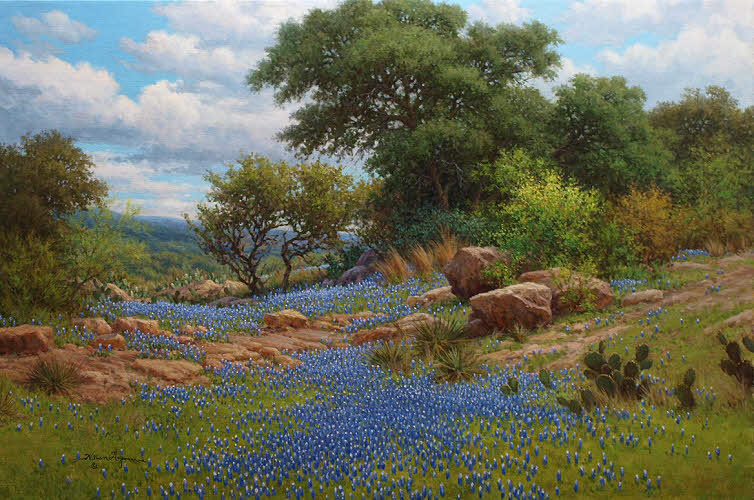
Author Archives: William

Some Do Not Do’s When Selling Art

Another title for this post could be “Prairie Dogs Can’t Sell Art.” Please read on.

My wife and I attended Septemberfest in Midland, Texas, which is an annual outdoor art festival on the grounds of the Museum of the Southwest to enjoy an afternoon of art and music. We also enjoyed watching a young child of about 6 dancing his little heart out in front of the stage. He wasn’t a scheduled performer, but he still took a bow and received clapping from the audience. That held our smile longer than anything that day.

As we made our way through the booth exhibits I couldn’t help but think about some of the Do Not Do’s when it comes to selling art that I learned from two marketing books written by Jack White, titled: “The Mystery of Making It” and “The Magic of Selling Art.” Before I elaborate on these books let me first tell you about what we experienced at the art festival.

One of the first booths that we went to was by an artist working in graphite pencil with western subject matter. We said hello to the artist first. My wife asked if she was the artist. I asked where she was from. The conversation was one sided. I took a liking to one of the small works of a well drawn horse head located at the bottom edge of her exhibit. I said out loud how I liked it. My wife also mentioned out loud which work she liked. I continued to look at the other artist’s work and then went back to the horse head drawing and said to my wife again out loud and pointing with my arm extended and finger pointing “I like that one!” The artist never got off her perch she was sitting on, nor offered to pick the work up so I could see it better, nor told me anything else that would tell me about the work, or why it was created or if it had any special meaning. NOTHING!! Helloooo, anybody home?? I can just imagine the artist saying in her mind “Oh I hope he buys it.” My wife did buy a set of $5 note cards from her to send to her brother. Actually she didn’t buy it from her, she just selected something off the card display rack and handed it to her to purchase it.

Another exhibitor was talking on her cell phone. She momentarily stopped to make some mention about her jewelry work and that it was done in sterling silver (I think) at which point she went back to her conversation on the phone.  OK. Bye, Bye.

Then we came upon an exhibitor with handcrafted wood boxes with different inlays of wood. We like boxes. Boxes with lids and drawers oh my! You can’t help but lift one to see what’s inside. The artist was sitting back in his booth. Never said a greeting, hello, welcome, thanks for stopping by, get out of my booth, drop dead. NOTHING!! However, I did learn he wasn’t mute because before we left his booth I did over hear him say to another artist, “Well, it looks like things are slowing down.” Good grief Charlie Brown.

Another exhibitor exuberantly popped forward and said “If there’s anything I can help you with, let me know,” and then quickly retreated into the recesses of their exhibit booth. Kind of reminded me of a Prairie Dog, who popped his little head out of his hole in the ground, sensed danger and retreated. Prairie Dogs can’t sell art either.

The above examples are of what NOT to do if you want to sell your work. My wife bought the note cards and I also bought a necklace for my wife at the festival, but that’s because she already has a good eye for jewelry, when it’s well made, at a good price and even better when it’s at a bargain price. I like that. But, the sell didn’t happen because of any special assistance on the part of the artisan.

I wonder how many of the above artists belly ached over how awful sales were and that they’d probably never be back to this festival because of people who have no appreciation for art. Where’s the appreciation of those who paid their fee to attend the festival, have to park a considerable distance and then walk some more through the maze of tents on a hot afternoon and then when we do come to a particular booth, we’re ignored? I know it costs artists to go and do these kind of shows, and it’s a lot of work to set up, but they decided to be there, so drop the attitude that those who attend should all bow and hail booth number 10 in the southwest corner. (Don’t know if there was such a booth, but sometimes you get that feeling of attitude floating around in the air although you do get some pleasant breezes by artisans who at least try.)

Perhaps this comes from artists who are gifted at their craft, but terribly lacking in knowing how to sell or jump-start a conversation. We’re not talking high pressure used car salesman tactics. No one likes to be sold. No one says, I’m going to go and be sold a car. Or I’m going to go and be sold a painting. No, they say I’m going to go and “Buy” a painting or I’m going to go and “Buy” a car. Effective selling is helping a person to buy what they want and be happy about doing so while giving them reassurance that they’ve made a good decision and that the art is going to enrich their life.

That’s where the above mentioned books were eye opening and instructive. The author, Jack White is a professional artist and was selected as State Artist of Texas in the 1970’s. He’s also husband to artist Mikki Senkarik. The first book I read was the Mystery of Making It. The heart of the book is the story of how with his guidance he catapulted the sales of his wife’s paintings starting in 1990 and went past three million in retail sales for her before the year 2000.
I also learned something about how much work to show at a time that actually helped to increase sales and what number of works caused sales to drop.
Then I read his Magic of Selling Art.  This is where he teaches you how to ‘soft sell’ and do so without ever resorting to lying to your customers. Basically it’s how to engage visitors to your exhibits or shows by asking them questions that can’t be answered with yes or no. Too many artists and even gallery personnel will greet a customer with “Is there anything I can help you with?” The general reply is “no we’re just looking.” They cut you off so as not to be sold. But if you ask them a question such as “Where are you folks from or with so many attending the festival where did you find a place to park? That’s a lovely necklace or handsome watch, where did you get it? Essentially people like to talk about themselves when someone else genuinely wants to know. A dialogue is started and in the process you may get to know their likes. They see you smile at them. They start to like you. Ask another question. What kind of art do you collect? If they linger looking at a piece ask: What do you like about that piece or where are you thinking of hanging this little gem? Essentially you’re working them towards closing a sale without their being “sold.”

I liken the advice from Jack’s books, not to that of a bald headed man trying to sell amazing hair growth tonic, but to someone with true to life examples in the art of selling. His and his wife’s experiences and what worked for them, written by an artist for artists. By the way, Jack also has a full set of hair.

Here’s the link to review his series of books on his wife’s website that if you’re an artist or in any field in which you have to sell something, you’ll benefit from reading.

http://www.senkarikstuff.com/books.htm

In an upcoming post I will write about his book “The Mystique of Marketing Art on eBay” and my own recent experiences following the advice I learned in this book.

Teaching Art

Teaching art has been a part of my life since the age of 15 when I taught my very first art lessons. Throughout those years and into the present, I’ve always endeavored to share what I know and what I’ve learned along the way. I just had opportunity to share some of that accumulated knowledge with a nice group of people on September 6, 2013 at the Ginger Lily, a small studio and gallery in the West Texas town of Lamesa.

In regards to the class, owner Ginger Witte, said this:  “I learned more about oil painting today, than I’ve learned in the last 40 years, combined! THANK YOU! Your entire presentation was phenomenal!”

She also stated this on her Facebook page. “An amazing amount of information, wonderful presentation with examples, continuous personal attention and consistent help. Great demonstrations – a FULL day of oil painting! William Hagerman is a Fabulous teacher! WoW!”

I appreciate those comments, but I also really appreciate the students and the questions they ask. This is what makes it special for me. I never consider any questions as being stupid ones, even if they think so. Teaching forces me to translate the why’s and what’s of oil painting, often using verbal illustrations to help the students grasp certain concepts as well as offering encouragement and motivation to continue in their artistic pursuits. Plus, it reminds me of the reasons I do what I do in my own paintings. So teaching often teaches me!

The following is me reviewing and discussing some of the basics of oil painting such as how to analyze color and mix it with the classes rapt attention. Thankfully no one fell asleep during the morning lecture!

William Hagerman Teaching Art at the Ginger Lily in Lamesa, TX

Here, I’m discussing and preparing to do a small demonstration to assist a student with the beginning stages of their painting as others also look on.

William Hagerman Teaching Art at the Ginger Lily in Lamesa, TX

All in all, It was a fun filled day of art instruction and painting for everyone. I look forward to the next months session and see their progress.

An Experiment in Color

Lakeside Cabin 9x12 oil painting by William Hagerman for eBay auction

This new little 9×12 painting listed on my eBay auction ending September 8, 2013 was a fun little experiment. Not that the subject matter was unique as it’s a simple little scene of a lakeside cabin at night. What is different is the color scheme of which is not generally associated with a night scene. Nor is it one that I have ever used before.

The technique although not a new one, but one that I seldom employ in which an under-painting in orange tones was first applied. This underneath layer influences the upper layers. I primarily wanted the effect to appear in the sky. After the first layer was dry, I over-painted with a yellowish green of low intensity. It was brushed on in a somewhat translucent application. I did not want to obscure the tone underneath. The result is it created a great mood to the painting. I hope to explore this color scheme more in depth in the future and apply it to one of my gallery or studio paintings once I hit upon the right subject and composition.

Again, you can catch my eBay paintings at: http://myworld.ebay.com/hagermanartI will try to have some painting offered each week, depending on my schedule. If nothing is posted, check back.

Also I will be teaching a full day art class in oil painting in Lamesa, TX at the Ginger Lily at 316 N. Austin Ave. I’ll share that experience in my next post.

Pricing and the Value of Art

frame

Have you ever watched the Antiques Road Show? When we have time my wife and I love watching it.  It’s always interesting to see the “wow” reactions when an item has great value or the disappointed look when a person learns their item isn’t as popular as it was a few years ago and now it’s not valued as much.

This also reminds me of the housing market. Sometimes the same house is valued at one price and then higher or lower at other times even within the span of a year or two. What drives the value? The market.

You’ve heard the term the “art market.” Is it any different? A while back I was visiting in a gallery and discussing different buying patterns or trends. In his gallery he said if a painting had a cowboy hat in it, he couldn’t sell it, unlike what it was previously when western art was very popular. He also mentioned other subjects that weren’t doing as well or as popular as they had been.

I thought again about the Antiques Road Show and how the market drove the price and the perceived value of something depending on the genre’s popularity. An artist may be faced with a dilemma in pricing art when an artist who might be painting a particular genre that’s popular at the time and is selling well, may suddenly finds sales have slowed and then realize the subject is not as popular as it was, yet the quality of the painting is still the same.  Perhaps during this “good” time an artist’s work appreciated in value and price. I’ve heard it said that artists can go up on their prices but can never come down. I’m wondering why not? When the market goes soft, do we just leave our prices the same and not raise them for a period and then just hope things pick up before the savings run out or perish the thought take on extra work outside of our artistic passion of painting, so we  can feed our family and pay the bills? Or do we adjust our prices to mirror what the market will bear?

Would doing so break some cardinal rule? Would it make our collectors unhappy if we had to lower our prices?  For those who invest in art and perhaps bought with the hope of prices going up, do not most who invest in things whether real-estate or art  know that what’s true of any other investments there’s always a risk the prices can fluctuate in response to the market? Or would they be thrilled that they can buy more of your work and when the market returns, they’re collection will be of even greater value? I was told by someone attending one of my art shows that they had wished they bought one of my paintings when they had a chance before my prices had risen.  What if due to a soft market the prices of the paintings were lowered and are now once again affordable for them?

Pricing in general has always been an issue for an artist with so many factors to consider. Some price paintings by the square inch. Perhaps with a slightly higher dollar amount for small works and a slightly lower one for large works to keep them all within a reasonable range. However, if one painting by an artist features mostly  sky, verses a painting of the same size with a complex composition of say a flower market scene that includes some type or building architecture, do you price it the same just because it’s of the same size? What about aesthetic values? Some paintings have a greater appeal and for that reason have a higher perceived value and naturally the price would reflect that or so one would think.

Well what do you think? If you’re a collector and love to buy art, but the overall art market is soft would you be upset if an artist’s prices were lower than before or be pleased to purchase more?

Artists; how do you manage your prices? Do have a system in which you use that has proved successful during downturns in the economy? How have you had to adjust? I would love to hear your comments.

Small Landscape Paintings on eBay August 23, 2013

The following are the latest off the easel paintings this week for my eBay auction which will end August 30th. Most new items are listed right after the old auction ends at 6 PM PST or 8 PM Central. To view the listing go to: http://myworld.ebay.com/hagermanart

Glowing Sunrise painting by William Hagerman copyright 2013

A “Glowing Sunrise” casts it’s light over the landscape with a sprinkling of bluebonnets nestled among the shadows of an outcropping of rocks and prickly pear cactus.

Happy Days painting by William Hagerman copyright 2013

“Happy Days” is the mood I felt for this composition of wildflowers in a field on a sunny day under a bright filled sky with white floating clouds. You can almost smell the fragrance of the flowers!

What’s been interesting for me in doing these paintings has been an exercise in simplifying my technique and style. Also it forces me to consider an entirely different market and to paint things that people will want to bid on. With so much on eBay and perhaps having to scroll through many little images of art, they have to stand out, so color and contrast is important. It’s also a learning environment as I see what images are bid on more or what seems to have a broader appeal. Some of these compositional ideas I’ve done for this venue may be expanded upon in a variation for a larger scale studio/gallery work in my regular style. It’s important that my regular customers and viewers realize that I have not abandoned my regular style for this one.

In the past I’ve sold some of my “plein aire” works as well which are even more impressionistic and I found that they too had an appeal for many. Therefore I decided to do these colorful paintings with more impressionistic notes and to reach out to other people who favor this type of work and at the same time introducing them to my regular works. Think of it as a new product line. The experience so far as been great and a wonderful way to advertise and even get paid for it! I appreciate very much the new customers and all the positive responses I’ve gotten.

Small Landscape Paintings on eBay August 13, 2013

On my previous post I introduced one of four paintings that was included in my first ever eBay auction. This endeavor was somewhat of an experiment and I was pleasantly surprised to see all of my paintings receive bids and sell. These paintings are different than my regular gallery work and are intended for eBay auctions. Thus they’re in a class all of their own. Production time is a factor, so I’m working the under-painting in acrylic and over-painting with oils. They exhibit more impressionistic notes whereas my full oil paintings are more detailed. I will be trying out a portrait smooth canvas to see what results I can achieve and if it allows more detail without increasing paint time.

As of this date I have 3 works on eBay. Glad to say they all have bids and they’re generating interest. One of the current paintings is shown here. Also just off the easel is another painting for eBay that will be included in my next auction. You can always see what’s listed here: http://myworld.ebay.com/hagermanart

Among so many offerings on eBay, and when someone is scrolling through pages of art, bright color and contrast is a key factor in having art stand out, so I’m contemplating what subject matter will do well in this online environment. So far so good. Suggestions or opinions on comparison of my gallery work vs. my eBay offerings?

sunset acrylic and oil painting by William Hagerman

Landscape acrylic and oil painting by William Hagerman

Small Landscape Paintings on eBay by William Hagerman

This is a brief post to inform you of a new and exciting opportunity to acquire one of my paintings in true auction style on eBay. There’s no buy now option or some hidden reserve bid. The auction starts at only $.01

That’s right only one cent!

This very first auction starts August 2, 2013 around 8 PM US central standard time and will run for 7 days.

In an effort to reach a wider audience I’ve completed four new 9×12 paintings on canvas. These paintings are different than my “gallery” works. These employ a technique where they are started in acrylic and finished with oil painted highlights and embellishments.

To find me on eBay you can go to: http://myworld.ebay.com/hagermanart
Once the auction starts you should be able to see the listed works on this page. Alternatively you can search for Hagerman Landscape Oil Paintings on the eBay search engine.

Here’s a peek at one of the items up for auction titled: Joyous Autumn. Hope you win!

Painting by William Hagerman


Just Off the Easel July 15, 2013

I’ve always enjoyed spring in the Texas Hill country. For many years I made regular trips traveling miles upon miles with my camera and paints to capture the beauty to be found along many county roads. Some not even paved!

This small painting is simply titled: Evening Bluebonnets, and was based on a photo I had taken from one of those trips to the Texas Hill  Country. It measures 11×14.

Evening Bluebonnets 11x14 oil painting by William Hagerman copyright 2013

The evening light was casting a soft glow and I loved the rocks and small stream. I did add more bluebonnets to the composition. If you would like to purchase any of my art, please feel free to contact me. You can also see what’s available here.

Just Off the Easel July 1, 2013

Ah, springtime in the Lonestar state of Texas featuring the state flower, the bluebonnet. This latest painting off the easel titled: Lonestar Spring is a 24×36 oil painting and is available at Griffith Fine Art in Salado, TX. (254) 947-3177 (note: this painting has sold)

Lonestar Spring 24x36 bluebonnet oil painting by William Hagerman copyright 2013

The Village of Salado if a great weekend getaway, with several bed and breakfasts and historic lodgings and is located off I35, between Waco and Austin, Texas.

As you stroll along Main Street in Salado you’ll see it’s a lively marketplace with something for everyone, whether your in the mood for fine art, antiques, pottery, collectibles, unique and handcrafted furniture, or gourmet foods to name a few. You can check out their events calendar to plan your trips.

Art Tips: A Minor Change and Major Effect on Painting Composition

This post is a short note about painting composition.

Ever play those visual games where you look at two similar images but they’re not exactly the same and you have to try and find the changes?

Well, here’s a comparison of one of my paintings. The top image has something that is missing from the bottom image. It doesn’t have anything to do with any color shift caused by my using a different camera, but some object in the landscape was removed. Can you find it? Secondly, why do you think it was removed? (Sorry that the image is a little out of focus but you can see the finished painting here:

Painting Comparison showing composition change

If you still don’t see it, look at the foreground area on the left. Notice a difference? The cactus is missing! Why did I remove it? It was distracting and interrupting the movement of your eye. Notice how you want to look at it and your eye sorta stays there. By removing it your eye movement flows easier throughout the painting.


For an artist, it’s wise to review your painting and try and catch anything that does not support the overall composition. Even minor changes can have big effects and big improvements on your art work.